
Table of Contents
What are Facebook Video Ranking Algorithms?
If you’ve ever uploaded a video to Facebook and wondered why some get far more views than others, you’re not alone. Facebook’s video ranking and recommendation systems play a major role in deciding what appears in people’s feeds and Reels.
Facebook doesn’t simply show every video to everyone who follows a Page or creator. Its systems try to predict which content each person is most likely to find relevant and engaging.
Understanding those signals won’t give you a magic formula for going viral. It can, however, help you make better decisions about what you publish, how you present it, and what you measure afterward.
2026 update: Facebook has been consolidating its video experience around Reels. The Videos tab became the Reels tab in 2025, and Facebook has been moving toward sharing videos as Reels regardless of their length or orientation. In this guide, “video ranking” therefore includes Facebook’s evolving Feed and Reels recommendation systems.
How Facebook Video Ranking Works?
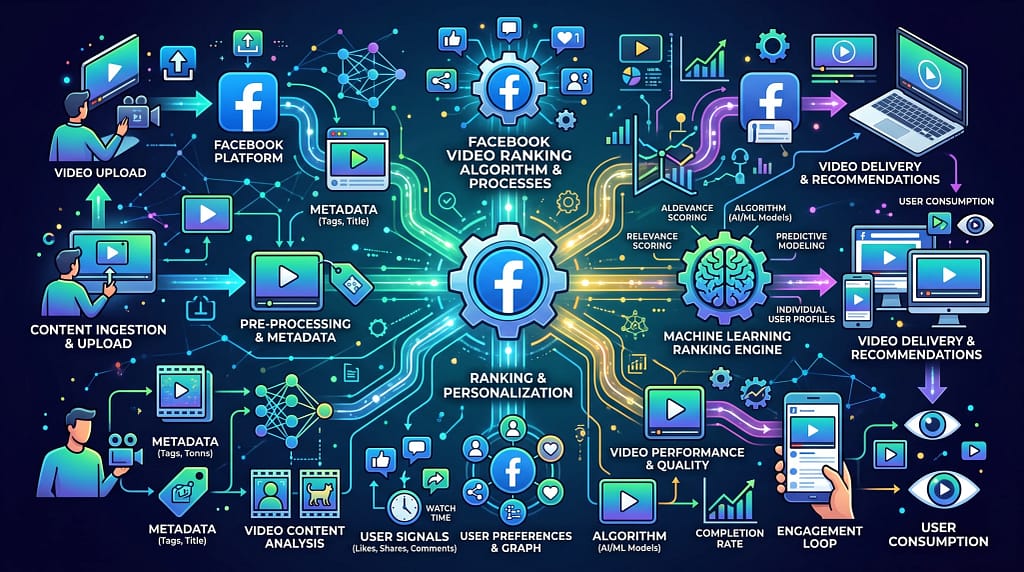
Facebook uses recommendation systems to decide which videos are most relevant to individual users.
These systems consider what people watch, interact with, share, skip and show an interest in. Two people can therefore receive very different video recommendations even when they’re using the same platform.
It isn’t simply about what’s newest. Facebook tries to understand the content, the creator and how individual viewers respond to different kinds of videos.
There isn’t one publicly available formula that tells creators exactly how every Facebook video will rank. Instead, Meta provides information about the types of content and signals its systems are designed to reward or reduce.
Understanding those areas gives creators and businesses a better basis for making videos that people actually want to watch.
Main Factors That Shape Facebook Video Distribution?
Several areas deserve particular attention.
Originality
Facebook increasingly emphasizes original content.
Meta says it is prioritizing original content in Feed and Reels while reducing the distribution of duplicative or minimally edited content.
Originality means more than making a few changes to somebody else’s video. Re-uploading content, stitching existing clips together, adding borders or captions, changing playback speed, or making other minor modifications may not be enough to make the result original.
Third-party material can still be useful when you add genuine creative value—for example, meaningful analysis, new information, substantial commentary or an original story built around it.
Practical lesson: don’t ask only, “Can I post this?” Ask, “What am I genuinely adding?”
Watch Time and Retention
Getting somebody to start watching is only the beginning.
Retention is one of the most useful performance signals creators can monitor and improve. If viewers repeatedly leave at the same point, that’s useful information—even if your opening was good enough to earn the initial view.
Look at where people lose interest. Did the introduction take too long? Did the video promise something it didn’t deliver? Is there repetition that could be removed?
Your audience retention data can help turn one video’s performance into lessons for the next one.
Engagement
Comments, shares, reactions and other interactions can indicate that viewers found a video interesting or useful.
But chasing interactions for their own sake isn’t the same as creating engaging content.
Ask questions when there’s a genuine reason for discussion. Encourage viewers to contribute when they actually have something useful to add. Create videos people might naturally want to share.
The objective is meaningful audience response—not engagement bait.
Relevance and Personalization
Facebook tries to predict what each viewer is interested in using previous viewing and interaction behavior.
If your target audience already has an interest in your subject or niche, Facebook has more context for determining whether your video might be relevant to them.
This is one reason having a recognizable subject and audience can be more useful than trying to appeal to everybody.
What Signals Can Influence Facebook Video Recommendations?
Think of signals as pieces of information Facebook can use to understand viewers and content.
Some useful areas to consider include:
- Viewing habits: What people have previously watched and interacted with helps Facebook understand their interests.
- Audience relationships: Previous interactions and viewing behavior can help Facebook understand which creators and subjects are relevant to an individual.
- Viewer response: Watch behavior, meaningful engagement and other reactions provide information about how people respond to a video.
- Content context: Clear titles, descriptions and other relevant information help viewers—and platforms—understand what a video is about.
- Captions and Thumbnails: Strong presentation can help viewers understand a video and decide whether to watch it.
Be cautious with articles that claim to know a fixed list of Facebook “ranking factors.” Meta’s recommendation technology evolves, and its systems are highly personalized.
How to Optimize Your Videos for Better Performance?
No one outside Meta knows every detail of Facebook’s recommendation systems, but creators can still make practical improvements.
1. Focus on Original, High-Quality Content
Invest your effort in content that adds something of your own. Avoid simply recycling popular clips with minor changes.
2. Hook Viewers Early
The opening matters because viewers can leave immediately.
Give people a reason to continue without stretching the introduction or delaying what the video promised.
3. Encourage Meaningful Engagement
Invite discussion where it makes sense. A natural call to action can work well when it gives viewers a useful next step rather than simply demanding a comment or share.
4. Publish for Facebook
When Facebook is an important distribution channel, create and publish with the platform and its audience in mind rather than treating it only as somewhere to drop links from another platform.
5. Use Captions and Clear Visual Presentation
Captions can make videos easier to follow in situations where viewers aren’t listening with sound.
Thumbnails, opening frames and other visual cues should accurately communicate what the viewer is about to watch.
6. Publish Consistently Enough to Learn
A sustainable publishing rhythm gives you more opportunities to understand what your audience watches and responds to.
That doesn’t mean Facebook automatically rewards a Page simply because it posts according to a schedule.
Prioritize useful, original content over publishing merely to fill a calendar.
7. Choose the Right Video Length for the Content
There is no single ideal Facebook video length.
Facebook recommends both quick clips and longer videos according to viewer interests. Instead of stretching a short idea into several minutes—or squeezing a useful explanation into a few seconds—make the video as long as the subject genuinely requires.
Then use retention data to see whether viewers agree.
8. Use Live When Live Makes Sense
Facebook Live can be useful for events, interviews, demonstrations, Q&As and real-time discussions.
Use it when live interaction improves the experience—not simply because you expect Facebook to automatically give every live video preferential distribution.
What are the Common Challenges and How to Manage Them?
Drop in Organic Reach
Organic reach can change because of competition, audience behavior, recommendation-system changes or simply because a particular subject is losing its appeal.
Experiment with formats, topics and presentation rather than assuming every decline is caused by “the algorithm.”
Copyright and Reused Content
Only upload material you own or have the right to use.
Copyright and originality are related but different issues: having permission to use something doesn’t necessarily mean Facebook will consider a minimally changed version original content.
Negative Audience Response
If viewers consistently skip, hide or abandon content, pay attention.
Your audience is giving you information. Use it to improve your next video rather than trying to force the same approach repeatedly.
Algorithm Changes
Facebook’s recommendation technology continues to evolve.
Follow official Meta/Facebook information when possible, and distinguish between what the platform has actually confirmed and theories repeated by marketers.
Why is Watch Time Useful?
Retention tells you how much of your video people actually watch.
If your analytics show a large drop at a particular point, consider tightening the edit, moving the hook earlier, removing repetition or getting to the promised information faster.
Rather than treating watch time as a magic ranking number, use it as evidence about how well the video is holding attention.
How Engagement Signals Matter?
Meaningful engagement can tell you whether content is prompting a genuine response.
Look beyond raw numbers. A thoughtful discussion in the comments, viewers sharing a useful video, or people returning for related content can tell you more than simply chasing reactions.
Building an active community also gives you a better understanding of what your audience actually wants.
Use Facebook’s Insights for Smarter Decisions
One of your best sources of ranking intelligence is your own performance data.
Facebook provides creators with performance information that can help you understand watch behavior, reach, engagement and how different videos perform with your audience.
Don’t just look at total views.
Compare patterns across several videos:
- Which openings hold attention?
- Which subjects attract meaningful comments or shares?
- Which videos get initial attention but lose viewers quickly?
- Which formats consistently work for your particular audience?
Your own data can answer questions that a generic list of “Facebook ranking factors” cannot.
Facebook’s Creator Assistant
In 2026, Meta began introducing Creator Assistant, an AI-powered tool designed to help creators understand their own content performance, audience and engagement trends.
Where available, it can complement your own analysis by identifying patterns and offering suggestions based on your content.
That reinforces a useful approach to ranking:
Publish → measure → learn → improve.
Instead of searching for one permanent algorithm trick, use each video’s performance to make the next decision better.
Real-World Facebook Video Strategy
The strongest strategy isn’t to optimize for one isolated ranking signal.
Combine the fundamentals:
- Create something original.
- Know the audience you’re creating for.
- Make the opening earn attention.
- Remove unnecessary material.
- Encourage meaningful interaction.
- Study your performance data.
- Test different approaches.
- Keep what works and change what doesn’t.
If you’re building a broader video strategy, V-Rank’s steps for beginners, advanced users and experts can help you decide what to work on next.
FAQs About Facebook Video Algorithms
Why did my Facebook video suddenly stop getting views?
There may not be one cause.
Changes in audience interest, competition, content performance, timing or Facebook’s recommendation systems can all affect distribution.
Check your recent analytics and compare the affected video with previous content before deciding what needs to change.
Is It Better to Make Longer or Shorter Videos?
Neither automatically ranks better.
Facebook recommends both shorter and longer videos. Make the video as long as the subject requires and use retention data to determine whether viewers remain interested.
How Much Does Posting Frequency Matter?
A sustainable posting rhythm helps you learn what your audience responds to, but don’t sacrifice originality or usefulness simply to maintain frequency.
Regularity is an operational strategy—not a guaranteed algorithm boost.
Does Original Content Rank Better on Facebook?
Meta has explicitly increased its emphasis on original content while reducing the distribution of duplicative and low-value reused material.
Creating something genuinely original—or adding substantial creative value when using third-party material—is therefore increasingly important.
Make the Most of Facebook Video Rankings
Understanding Facebook video ranking doesn’t mean trying to reverse-engineer every line of an algorithm.
The more durable approach is to create original content for a recognizable audience, make every part of the video earn its place, study what viewers actually do and adjust based on evidence.
Facebook’s systems will continue to change. Specific tactics may come and go.
Creators who publish, measure, learn and improve don’t need to depend on one permanent algorithm trick.
SEO for vloggers on Amazon
Keep Exploring V-Rank
Creating a great video is only part of the journey. Getting it discovered, watched, and ranked is the next challenge.
V-Rank brings together practical guides, tools, and resources for improving video visibility—from video creation and SEO to platform algorithms, audience engagement, and ranking strategies.
New to video ranking?
Start with the Starter guides and build the fundamentals step by step.
Already know the basics?
Explore Advanced strategies for improving visibility, engagement, and performance.
Looking for deeper insights?
Visit the Expert section for more detailed ranking strategies and analysis.
Or browse the Latest Blogs to see what’s new on V-Rank.
Keep Learning. Keep Testing. Keep Ranking.
Video platforms change. Algorithms evolve. Tools come and go.
The goal of V-Rank is to help you understand what matters, test what works, and make better decisions about getting your videos discovered.
Wishing you the best of luck in achieving the top position!
First steps as a vlogger?
Visit Vlogsuite with tips and tools for vloggers
May you soar to rank #1 and celebrate your success with joy and excitement! 🚀 🏆🎉
Good luck ✨
Learn how to monetize your own website and sign up for free
This is an affiliate link to a tested platform that’s great for beginners who want to learn web development.
And make your own images
Keep visiting and spread the word! Thank you!
https://v-rank.com/about-v-rank-focused-on-tips-and-practices-for-promoting-videos